

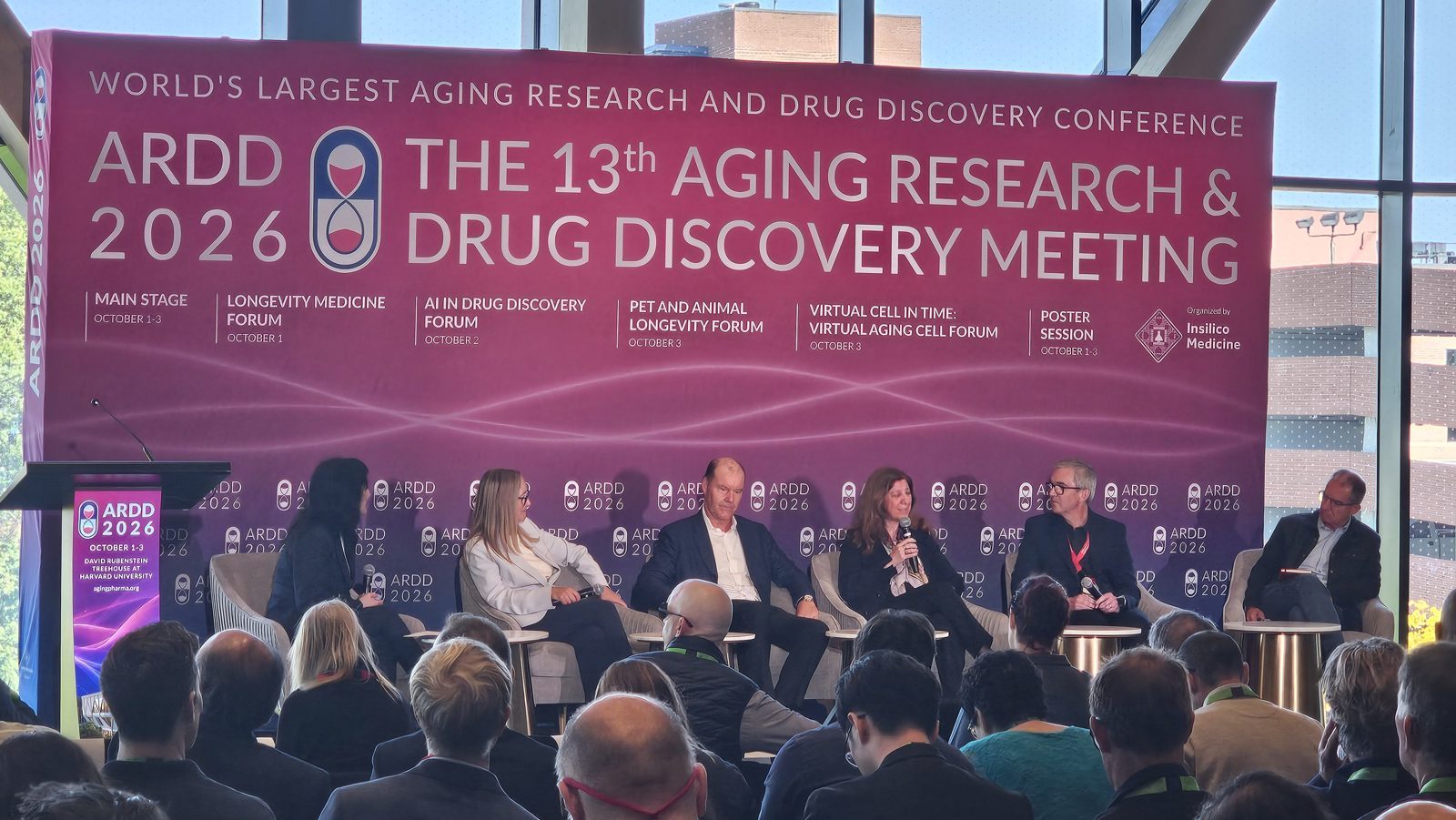
That is how Alice Park of TIME framed the pharma chief executive panel she moderated at ARDD 2026 at Harvard on Friday morning: mopping off the floor without turning off the faucet.
On stage were Christophe Weber, ex-CEO of Takeda; Elcin Barker Ergun, CEO of Menarini; Fiona Marshall, President of Biomedical Research at Novartis; Ariel Feldstein, CSO of Internal Medicine at Pfizer; and Stéphane Bancel, CEO of Moderna.
Medicine has become very good at the mop. It treats disease once it has arrived, often for the rest of a patient's life. The faucet is aging itself, and the slow drift that comes before chronic disease. The panel kept coming back to why turning it off is so hard.
The system pays for the mop
Christophe Weber named the problem: "the healthcare system has not moved to prevention."
As I see it, the science of prevention has moved on while reimbursement and trial design have not. A drug that keeps people healthy has to prove it in trials that can run for years, and then find someone willing to pay for an illness that never happened.
Fiona Marshall added a second problem. Every new medicine has to convince five audiences at once: the patient, the physician, the provider, the payer and the regulator. Each needs different evidence. She gave one reason obesity drugs took off: "it's so clearly visible that you are having that benefit." Statins struggle with adherence because "people can't see that their cholesterol levels have gone down." A new cholesterol drug still needs a cardiovascular outcome trial of around eight years.
Pfizer: think in axes
Ariel Feldstein described how the new obesity and metabolic drugs changed Pfizer's thinking. With them the company moved from treating isolated diseases to treating the whole cardio-renal-metabolic-neuro axis. Millions of people on them now give a live view of every system that matters for healthy aging. Targets grounded in human biology, he said, raise the odds of success. He also wants more proof-of-concept trials in healthy people.
Novartis: they grew the tissue
Earlier that morning, Fiona Marshall had given an unusually open keynote. She walked through two Novartis programs that did what they were designed to do.
The first regrew cartilage in the knee. It showed on the MRI. In people with osteoarthritis, it did not translate into less pain or better mobility.
The second was an antibody that built lean muscle. In people with age-related muscle loss, it did not improve mobility either.
Her conclusion: regrowing one tissue is not enough. Aging runs through the whole body, so the answer has to include the whole system: exercise, behavior, nutrition, and probably combinations. Novartis has built a new department around diseases of aging and broadened its focus from regeneration alone to resilience. Why do some people with brains full of amyloid stay cognitively sharp? Why do some hearts take serious stress and keep going?
She also named the strongest lever we already have. Physical activity lowers risk across heart disease, dementia and more, and she put its effect on Alzheimer's risk on a par with, or above, the APOE4 risk gene. One intervention reaches many systems at once.
A brief for the faucet
I think the morning added up to a brief for anyone building healthspan products:
- Work on the whole system. Single-tissue fixes stall.
- Start in healthy people, before disease sets in.
- Deliver a benefit people can feel in their own lives.
Why we work on the gut
This is the brief we set ourselves at Trilliome. The gut is one of the few places in the body that reaches the brain, metabolism and the immune system at the same time. Its bacteria make signals that reach all three. Some of the key species that make them lie dormant. We develop ingredients that wake them back up, for people to take every day while they are still healthy.
Exercise proved that one intervention can touch many systems at once. I believe the gut is the other place where that is possible. That is where we want to turn off the faucet.
Thank you to Alice Park and the panel, to Fiona Marshall, and to the ARDD team for a morning this open.